
Entity Optimization for AI Search: Reducing Ambiguity and Increasing Retrievability

Entity optimization for AI search isn’t a checklist of SEO/GEO tactics; it’s a holistic process centered around reducing ambiguity and increasing retrievability for your brand’s key entities.
When you optimize an entity (like your brand name) for AI search, you help search engines and AI assistants reliably identify it. This means the search systems understand what the entity is and associate it with the right concepts, distinguish it from similarly named entities, and (very importantly) find corroborating evidence about the entity across the web.
Entity optimization traverses several key pillars of AI search, including traditional entity SEO, knowledge graphs, semantic or vector search, and RAG-based AI search.
In this article, we’ll discuss how to optimize your entity for AI search, not with a checklist, but with a holistic strategy backed by third-party sources.
Here’s a video to accompany the article, as well:
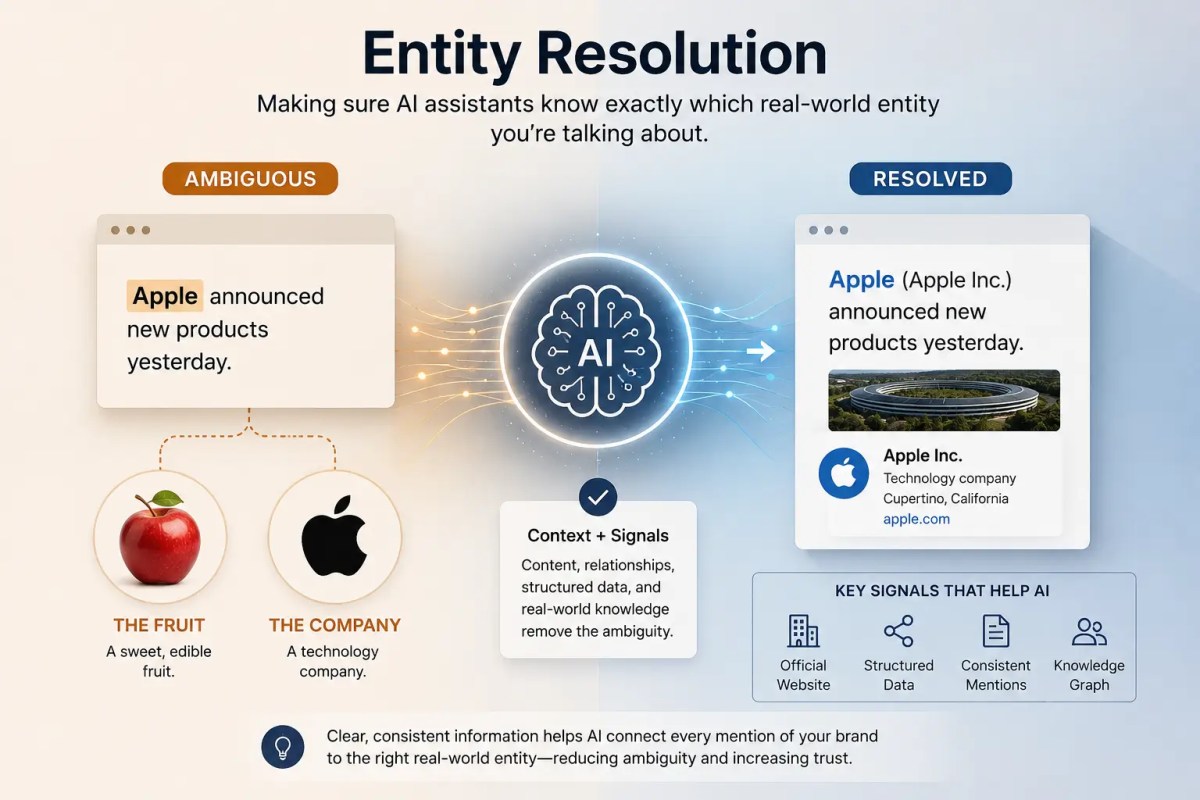
The first step is “entity resolution,” or making it unmistakable what the brand is.
Your ultimate goal is to have an AI assistant associate your brand with core entities of relevance, like “enterprise SEO software” or “AI search consulting.”
But before you worry about that, make sure the AI assistants can confidently determine who you are by understanding that all references to your brand refer to the same real-world entity.
For example, if a page mentions “Apple,” Google needs to know if it refers to the tech company or the fruit. That’s entity resolution.
Google says Organization schema can help it disambiguate an organization, like by understanding administrative details. Google thus recommends properties such as:
namealternateNameurl(helps Google uniquely identify the organization)logo- physical/contact details (where appropriate)
sameAs(for links to external profiles)
Organization structured data is a good start toward entity resolution. But I wouldn’t stop there.
Here are some other practical steps I would take:
- Use one primary brand name consistently.
- State what the company is on the homepage, About page, and in the footer.
- Mention alternate names, abbreviations, or previous names where needed.
- Keep logo, domain, business details, social profiles, founder information, and descriptions consistent.
- Use persistent URLs for the entity and its important people or products.
Practically speaking, the goal isn’t repeating the brand name everywhere. It is more about minimizing entity ambiguity through repeatable, reinforcing signals.
Next, we’ll speak about “vectors.”
The modern semantic retrieval systems that power traditional and AI search systems can represent text and other media as embeddings: numerical vectors that encode semantic information.
Semantically related items tend to occupy closer positions in embedding space, and Google’s BigQuery documentation specifically says vector search is used to power products including Google Search and YouTube.
Thus, we want to think about entities in terms of semantic neighborhoods, not just literal keywords.

If Brand A has the following semantic connections: Brand A → marketing → business → software → miscellaneous.
And Brand B has these semantic connections: Brand B → SEO → AI search → generative search → semantic search → content strategy → enterprise marketing.
Then Brand B lives in a much clearer semantic neighborhood, likely giving it a competitive advantage.
Based on the workings of semantic or vector search, a reasonable entity optimization objective is to build consistent, meaningful associations between your brand and the topics you want it understood for.
This would be a good time to check out my tips for extractability in content if you haven’t already.
Thirdly, if you want a machine to understand an entity, give it clear “Brand → Attribute relationships.”
You can think of these as simple subject → predicate → object relationships, or semantic triples.
Examples might include:
- Nike → manufactures → athletic footwear
- Ahrefs → provides → SEO software
- Ethan Lazuk → specializes in → SEO and GEO
Adding schema makes relationships explicit by attaching properties to entities, and Google says structured data provides explicit clues about the meaning and classification of page content. But I would make these relationships clear in natural language too, not just JSON-LD.
Replace vague copy like: “Ethan helps brands achieve digital growth.” with more entity-rich content, like: “Ethan Lazuk is an independent SEO/GEO strategist who helps brands and agencies achieve visibility in AI search surfaces like AI Mode and AI Overviews.”
This isn’t to say that semantic triples are a Google ranking requirement. They aren’t. But rather, their value is the explicit relationships they create, which reduces semantic ambiguity for both people and AI search systems.
Speaking of content, the next step is to build “topical depth around the entity,” not just topical authority for the website.
Traditional topical authority thinking often asks, “Does this website comprehensively cover the topic?” while entity-oriented thinking asks, “Is this specific brand meaningfully and repeatedly associated with the topic?”
Kalicube has a related idea called “niche notability,” where instead of trying to become broadly famous, you establish your entity as notable within the specific niche where you want algorithms to understand and recommend it.
Search Engine Land has also argued that topical coverage by itself isn’t enough for AI search because the system also needs to understand who the publisher or entity is in relation to the subject.
So let’s put this in a practical light: if Brand A wants to own an association with “AI search analytics,” it isn’t enough to publish 100 AI-search articles. Rather, the broader content ecosystem should also repeatedly establish meaningful relationships, such as:
- Brand A → specializes in → AI search analytics
- Brand A → develops → AI visibility software
- Brand A → researches → AI search behavior
- Brand A → measures → brand visibility in LLMs
In short, don’t just build “topical authority” around a website. Build “clear relationships” between the brand and the topics you want it known for.
To that end, you’re looking to build a “network of entity corroboration.”
Suppose your own site says:
“We’re an enterprise AI-search analytics platform.”
That’s one assertion, and it’s not enough for corroboration.
But then imagine that the same basic relationship appears independently on:
- conference speaker bios
- industry publications
- podcasts
- software directories
- analyst pages
- association websites
- partner websites
- news coverage
- interviews
- research citations
That’s a network of corroboration, giving clarity to your core entity.

It’s not important that every source uses identical wording but rather that the underlying facts and associations converge, so called semantic consensus.
But this works both ways. Inconsistent descriptions of your brand across the web can make entity understanding more difficult for AI search systems. That’s why it’s important to audit your third-party mentions for consistency.
Because, ultimately, “mentions” may matter independently of links.
Traditional SEO was accustomed to backlink outreach as a form of authority building.
However, Ahrefs analyzed 75,000 brands and reported that brand mentions showed the strongest correlation with brand visibility in Google AI Overviews among the factors they studied. Of course, that’s correlation, not causation, but it’s interesting nonetheless for our entity optimization strategy.
The importance of mentions for AI visibility means that entity-oriented digital PR strategy is broader than getting backlinks; it’s about getting your entity discussed in the right contexts by sources that help establish what your entity is known for.

Independent mentions thus contribute to the network of entity corroboration, and achieving them is a separate strategic initiative from link building.
Of course, your entity needs a home for other sources to reference: an “entity home.”
Entity home is terminology popularized by Kalicube and defined as the page an organization controls that serves as the primary reference point for the entity’s identity, attributes, and relationships.
Usually, an entity home is an about page, but it could be the homepage or even a definition or service page.

What’s important is that the entity home answers key information about the entity:
- Who is this entity?
- What type of entity is it?
- What does it do?
- Who founded it?
- Where is it based?
- What products does it offer?
- What subjects is it associated with?
- Which other entities is it meaningfully connected to?
The entity home defines the node. The rest of the site defines the graph around it.
Because, we have to think about the website more broadly as an “entity graph.”
Schema App advocates for what it calls “internal entity linking,” where entities defined on the site are explicitly related to other entities.
We talked before about Organization schema. But an organization isn’t one isolated entity. It sits inside an entity ecosystem:
Company
→ founded by → Person
→ creates → Product
→ belongs to → Category
→ solves → Problem
→ serves → Audience
→ operates in → Location
→ publishes → Research
→ written by → Experts
WordLift similarly advocates for building knowledge graphs where entities gain meaning from their relationships rather than existing as disconnected data points.
So don’t think of schema as decorating webpages. Think of it as a way of expressing your entity model.
But as we said earlier, these relationships shouldn’t only exist in JSON-LD but also your written, customer-facing content. Use simple declarative relationships (semantic triples) to make entity facts less ambiguous and easier to translate into structured relationships.
But also remember that we want “credible entity relationships,” not random associations.
Being related to more entities isn’t automatically better. Relationships on your website become valuable, whether they’re in schema or on-page content, when they provide real-world evidence of relationships.

Weak relationship:
Brand A → mentions → Stanford University
In that instance, Stanford just happens to appear in an article.
Meaningful relationship:
Brand A → research partnership → Stanford University
An entity graph shouldn’t simply contain more edges. It should contain defensible edges.
Because first the AI search system needs to understand who you are. Then there needs to be evidence supporting why you matter. Only then does the question become when you should be surfaced to a user.
In terms of understanding where your entity optimization efforts stand, think about “Knowledge Panels as a diagnostic.”
The Knowledge Panel becomes almost like an observable output of Google’s entity reconciliation process.

From it, we can observe:
- Does Google recognize the entity?
- What type does it assign?
- What subtitle or category appears?
- Which people are associated with it?
- Which social profiles appear?
- Which related entities appear?
- Are there duplicates?
- Is Google confusing it with another entity?
As a caveat, keep in mind that a Knowledge Panel means Google has structured information about an entity, not that the entity will necessarily rank or be cited in AI Overviews.
Case study: creating “proprietary entities” with Hamsterdam.
A brand doesn’t have to optimize only its corporate entity. It can create other identifiable entities that reinforce the parent brand, or proprietary entities.
My Hamsterdam, Hamsterdam History, and Hamsterdam Research projects are good examples.

Instead of having:
Ethan Lazuk → writes → SEO articles
These projects help me create a richer network of entities:
Ethan Lazuk → created → Hamsterdam
Hamsterdam → covers → SEO/GEO
Hamsterdam Research → analyzes → AI/search research
Those are differentiated concepts that can accumulate their own mentions and associations while pointing back toward the parent entity.
So, instead of every piece of content reinforcing only one entity, proprietary projects can create multiple interconnected entities that reinforce one another.
Finally, how can we measure whether the AI search systems’ understanding of our entity is actually changing?
We talked about Knowledge Panels as a diagnostic, but we can go more in depth on entity optimization measurement.
Things you can monitor include:
Entity accuracy:
- AI descriptions
- Knowledge Panel attributes
- category/type
- associated people/products
Entity associations:
- associated topics
- co-occurring entities
- competitor associations
- sentiment
Entity visibility:
- citations
- non-branded recommendations
- branded SERPs
Web consensus:
- third-party descriptions
- inconsistencies across sources
I’d particularly monitor accuracy, not only visibility. “What does the AI believe we are?” may be more useful than “How many times did it mention us?”
Takeaways
Entity optimization for AI search is a strategy, not a checklist of tactics.
We can summarize the key takeaways with a list of questions:
- Identity: Can the AI search system identify and disambiguate the entity?
- Meaning: What attributes, categories, topics, people, products, and concepts does the system associate with the entity?
- Corroboration: Does the rest of the web reinforce those relationships?
- Credibility: Is there credible evidence explaining why this entity matters for those topics?
- Retrieval: Can semantic (vector), lexical, graph, and conventional retrieval systems surface information about the entity for relevant queries?
- Citation: Does the entity produce information useful enough to retrieve as supporting evidence?
- Recommendation: Does the entity surface when the query asks for a solution or category without naming the brand?
That last part is huge:
Entity recognition: “Tell me about Brand A.”
Entity retrieval: “Does Brand A offer AI visibility tracking?”
Entity recommendation: “What companies can help me measure visibility in AI search?”
Recommendation is where brand positioning, entity SEO, semantic search, and AI search start to converge, and it is an end-goal of entity optimization.
If you want a hand with your entity optimization strategy, get in touch with me. I’m an independent consultant helping brands and agencies with their SEO/GEO goals.
Until next time, enjoy the vibes:
Thanks for reading. Happy optimizing!

Related posts
What Makes a Webpage a Good Candidate Source for AI Overviews and AI Mode? A Case Study Using My NYC Consulting Page
What Makes a Webpage a Good Candidate Source for AI Overviews and AI Mode? A Case Study Using My NYC Consulting Page Are you curious…
People Tell Me What to Say: Creating Helpful, Reliable, People-First Content for Google Search & AI Assistants in 2026 & Beyond (An SEO/GEO Deep Dive)
Learn why current SEO tactics may be creating search engine-first content that’s hurting your visibility on Google Search in light of AI-based ranking systems like…
Extractability for AI Assistants: 11 Tips for SEO/GEO Content Creation
Extractability for AI Assistants: 11 Tips for SEO/GEO Content Creation Extractability refers to how easily AI assistants can understand useful passages from your content and…
Leave a Reply