
🐹 Hamsterdam Part 65: Weekly SEO & AI News Recap (7/1 to 7/7, 2024)
By Ethan Lazuk
Last updated:
A weekly look-back at SEO & AI news, tips, and other content shared on social media & beyond.

Opening notes, thoughts, and musings:
- Welcome to a new week of Hamsterdam! 🐹
- I appreciate you being here, and look forward to sharing the week’s news! 🙌
- Fancy a longer read? Check out my other blog content from this week:
- 🤓 How does Perplexity work? A summary based on recent interviews
- 🧘 Comparing a YMYL page’s content in 2017 vs. 2024 (Hamsterdam History)
- Bonus: Check of my TikTok finds of the week (a little bit of everything) 💎
We also deliver! — Subscribe to the Hamsterdam newsletter. Hot and ready in 30 minutes or less 🍕, or sent out every Sunday. (One of those two.)
If you’re in a rush, hop down to the news portion. 🗞️
Or continue reading for two vocabulary lessons, this week in SEO history, plus an introduction. (Don’t forget to click the dropdowns.)

And we’re off …
#️⃣🤳👀 Marketing word of the week: “Hashtag”
Pound sign, number sign, octothorpe, hashtag, fragment identifier, tic-tac-toe thingamajig — however you call it, it’s good to know what the #️⃣ symbol is, especially if you work in marketing or SEO.
What’s cool about the “hashtag,” as we’ll call it here, is that it went from an obscure symbol on telephones and computers in the pre-internet era to having a ubiquitous presence in the realm of social media and even offline marketing.
And, oh yeah, it’s used to anchor jumplinks on webpages, too, like what you’ll see in a table of contents or from Google’s featured snippets or AI Overviews (or in this old video I made).
But let’s get one point out of the way first: hashtags won’t directly improve the visibility of your content on Instagram:

Extrapolate from that more broadly what you will (but I like to think of it as user-first optimization isn’t just for SEOs 😉).
Here’s an overview of the different ways hashtags are used, and then we’ll get into their history and modern applications, with examples:
- Pound sign: On telephone keypads, the pound sign is mostly used to signal the end of a selection or input, but it has other uses, like accessing special features (conference calling, etc.).
- Number sign: In writing, it’s an abbreviation of the word “number,” but it also has connotations in music (sharp note) and proofreading (insert a space).
- Octothorpe: In early computing, the octothorpe was used to denote comments, or non-executable lines of code, but it could also be used for preprocessor directives, like in C and C++.
- Hashtag: With the rise of social media, the hashtag became a way to group related content together, but it’s also become a means of creating brand awareness or doing trending topic research.
- Fragment identifier: These are used in webpage URLs to anchor links to a particular section of content, either on the same page or another one.
🚨 ⬇️ 👈 Click here to check out hashtag examples and (a lot) more details (if you want 😎).
The pound sign on phones used to play a bigger role. (If you recall in Hamsterdam Part 63, we featured Americana by The Offspring (👈 jump link), where the intro says, “Please make your selection followed by the pound sign now.”)
However, modern systems use AI voice recognition technology (NLP) or touch-tone interfaces that innately understand various number combinations.
Here’s an example of the pound sign on a ’90s-era phone:

Despite what I said about hashtags for Instagram, they do serve a purpose for social media.
The hashtag was invented on Twitter in 2007 by Chris Messina. A blogger, product consultant, and open-source advocate, Chris proposed using hashtags to group related tweets together.
Twitter embraced the idea, made the hashtags clickable, and the idea spread quickly across platforms. Marketers capitalized (and abused) them.
We even see hashtags used in offline marketing:

The trick with social media hashtags is to tread lightly and use them smartly, like you would with links on a webpage.
Here’s some good advice from SgGradSister on Reddit for using hashtags on TikTok:
Don’ts:

Dos:

Personally, I’d advise using hashtags only for your audience’s benefit.
Today’s social media users are savvy, in my opinion — as many grew up using social from the jump — and spammy tactics or gimmicks will only hurt your brand’s reputation long term.
🔥 Now for the funnest (or most fun?) use of all: fragment identifiers.
I’d recommend reading Cindy Krum’s article on fraggles for MobileMoxie:

👆 See that “Source” link. That’s a jumplink to the MobileMoxie page using a feature in Chrome:

It’s the same technology Google uses in featured snippets and AI Overviews. If you look at the URL for an AIO source, for example, it adds a hashtag with extra stuff:
/hashtags-on-facebook#:~:text=3.-,Hashtags%20help…
You can add jumplinks yourself with this <a> tag for the link:
<p><a href="#part-of-the-page">Click here to jump down.</a></p>And this ID for the anchor (where users land):
<p><a id="part-of-the-page"></a>Hurray, you've landed here!</p>“But won’t that mess up my rankings in Google?!”
You’ll see fragment identifiers in your Google Search Console performance report, if they get impressions:

However, the page is still canonicalized to its primary URL (without the fragment identifier), so its ranking signals get consolidated there, but that’s just in theory.
This was said by John Mueller before (albeit in a deleted tweet):

But he also reaffirmed it on LinkedIn in June 2024:

👆 He even used some hashtags in his post. 🙌
“But won’t this mess up my internal linking and PageRank flow?!”
Google usually ignores everything after the fragment identifier (albeit, according to a deleted tweet):

When I link here to a section of a past Hamsterdam recap where John says fragment identifiers aren’t related to canonicalization, for example, Google’s systems likely see that as a normal link to the page itself.
“So does this mean the keywords I use for anchor text to sections of my page will contribute signals for that page’s overall topical meaning?!”
I guess, but doesn’t that make sense, naturally?
“Cool.”
Again, though, it’s possible — and I would almost expect — for Google’s system to be more complex, especially given how important document chunking has become for LLMs, but the above is what we know, today.
Lastly, there is something called a “hashbang,” which is #️⃣ and ❗️together. It was used in older JavaScript frameworks to indicate content changes without requiring a full page reload.
Google used to support hashbangs, but that was deprecated in 2018, likely due to slow load times and poor UX. Instead, there are more SEO-friendly JS implementations.

Here’s a jumplink to their developer doc’s explanation.
🚨 Update (7/8): Barry Schwartz reported at SER today that Google has updated (👈 jump link) its URL structure best practices doc to mention:
“Don’t use fragments to change the content of a page, as Google generally doesn’t support fragment URLs. If you’re using JavaScript to change content, use the History API instead.” (My highlight and bolding.)
– URL structure best practices for Google (Google Search Central)
It then showed an example similar to: “example.com/#️⃣/tofu” — so that’s another instance to be aware of. (I’m not a JS developer, so listen to what Google says. 😅 🙌)
#️⃣and-im-audi-5000
🐵➡️🙈➡️🙉 AI word of the week: “Hidden layer”
Nested between the input and the output layers of a neural network are its “hidden layers.” These are where the computations take place that enable the model to learn complex (nonlinear) patterns and representations from data.
Note: All images used below are from “Lecture 1: A Brief History of Geometric Deep Learning” by Michael Bronstein.
It all started with a single perceptron:

It’s a single-layer neural network with no hidden layers 👀:

Stacking multiple perceptrons together into multiple hidden layers results in a “deep neural network,” the foundation of deep learning models 🤿:

Modern deep learning architectures also use more sophisticated types of neurons than simple perceptrons, such as convolutional and recurrent neural nets, which are tailored to specific types of data.
🚨 ⬇️ 👈 Click to continue reading about graph neural networks and universal approximation (if you want 😎).
While traditional neural networks are great at processing data in regular or grid-like structures (think images or sequences), many real-world problems involve interconnected data that’s best represented as graphs.
Graph neural networks (GNNs) apply neural network principles to these, where nodes represent entities and edges represent relationships. By aggregating information from neighboring nodes, GNNs can capture complex patterns and dependencies, such as for recommender systems, social network analysis, or drug discovery.

It’s not so much the number of layers, though. Universal Approximation Theorem posits that a single hidden layer, given a finite number of neurons, can approximate any continuous function:

Overall, deep networks tend to outperform shallow ones, given their ability to learn hierarchical representations.
Hidden layers typically use nonlinear activation functions (ReLU, sigmoid, tanh, etc.) to introduce complexity and allow the network to learn the relationships in data.
The neural network learns through backpropagation, where the weights of connections between neurons are adjusted based on the loss function (error) using gradient descent.
Gradients (degrees of adjustment to weights) can vanish or explode (get small or big) in deep networks, requiring methods like batch normalization. Other challenges include overfitting and underfitting, as well as the computational resources required for model training.
In short, hidden layers of neural networks perform feature extraction and transformation. In deep neural networks, the first hidden layer learns simple features from the input data (say the edge of an image), while deeper layers extract more complex combinations of features (like facial features or the structure of a car).

It’s this process of feature extraction that creates generalizable models that can learn from training data how to make accurate predictions on new, unseen data.
This week in SEO history: CSS-Tricks (2007)
Special note: robots.txt was born this week, back in 1994. We wrote about this and its creator, Martijn Koster, in a past history lesson about ALIWEB. 👈 That’s worth checking out, ICYMI. There are also some LI posts about robots.txt from Gary Illyes in the technical SEO section later.
This week, though, we’ll talk about CSS-Tricks, a portal for web designer news and tutorials. It was established by Chris Coyier, a web designer, on July 4th, 2007.
It’s still active today:
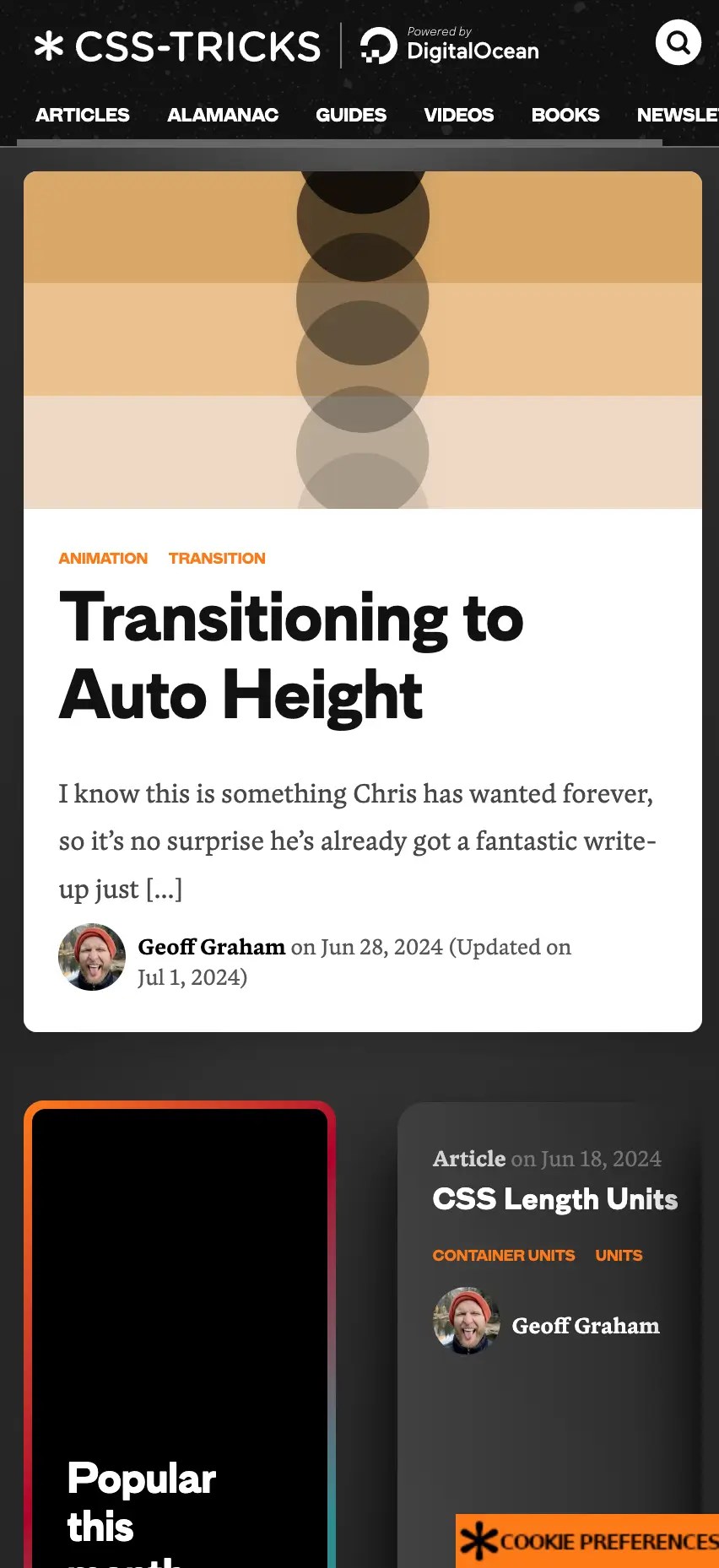
Back in 2007, this was how it looked to visitors:

CSS isn’t something we discuss much in SEO, at least directly, but along with HTML and JavaScript, it’s foundational to websites.
Well-structured CSS files can benefit page load times, and mobile responsiveness is crucial for UX (as we’ll explore in the dropdown). 📱
As search engines get better at understanding webpage content and inferring quality and relevance signals from user interaction data, that makes design, CRO, and brand identity all the more important to incorporate into a holistic SEO strategy.
Good alignment with CSS best practices counts. 🧑💻
🚨 ⬇️ 👈 Click to look at a 2007 CSS tip vs. today’s context (if you want 😎).
Back in 2007, one of the featured articles on CSS-Tricks explained how web designers need to consider their audience’s screen resolutions (like 800×600).
Smaller screens (especially on older computers), couldn’t display as much content, so parts of website designs might appear cut off, causing users to scroll horizontally. ↔️

The concept of designing for your users’ devices is timelessly good advice. 🙌
Of course, the circumstances are a bit different today. According to StatCounter, here are the most common desktop screen resolutions as of last month:

I can’t remember the last time I had to scroll horizontally on a laptop or desktop. We’re mostly playing on bigger screens today.
That said, I have had to scroll horizontally on mobile, like when page elements (such as a naked link or non-dynamic chart) extend beyond the viewport.
Another big issue I find is with mobile load times. 🐢
It’s easy to fall prey to thinking desktop is what counts, because that’s what we’re usually on for work. It’s also easy to think everyone’s smartphone is hooked up to Wi-Fi or a 5G connection.
Back in 2009 (two years after CSS-Tricks started), this was the global device breakdown:

Compare that with today, where mobile is almost at two-thirds:

I constantly have to remind myself to take screenshots that work for mobile users when I add content to my site. 😅
When it comes to evaluating your content’s layout, mobile preview is your friend, as is throttling. 🏁
😌 Introduction to week 65: No worries
My sister, Abbey, has a subscription to Paramount+, so I’ve been watching new series, like Halo and the Frasier reboot, but also reruns of past shows, like Roast Battle and Ink Master.
Last night (or maybe a few nights ago, depending on when you’re reading this) I was watching a rerun of Ink Master where a judge said something, and I thought, “That’s a great point!”
If you’re not familiar with Ink Master, it’s a competition among tattoo artists.
I have 0 tattoos, but I’ve been around the culture periodically over the years.
In fact, I went to elementary school in Montana and used to go snowboarding with someone who is now a phenomenal tattoo artist. Check out her work on Instagram:
I’m not here to tell you if Ink Master is the pinnacle of tattoo culture. (You can form your own opinions on that.)
But getting back to this Ink Master episode, one of the artists discovered that another artist, a top-performing competitor, was using references for their tattoos.
No big deal, right?
Well, the resemblance between the references and their artwork was pretty close.
It’s kind of a touchy subject how much original art (and drawing talent) someone puts into their work.
Anyway, the first artist brought these “tracing” allegations to the attention of the judges.
The first judge basically said, “Don’t worry about what everyone else is doing. Focus on yourself.”
Wow, I mean, it’s obvious advice, right?
But at the same time, it’s not so obvious.
That word “competitor” is ubiquitous in the context of SEO and marketing.
It’s all about besting your competitor, being more authoritative, trustworthy, click-worthy, a better expert, and ruling the SERPs.
But is it?
As a business owner doing digital marketing, why should I care what my competitors are doing, especially if my goal is to build my brand and satisfy my audience of customers?
Of course, we can take creative inspiration or strategic insight from competitors.
But there’s also a fine line between inspiration and imitation.
Personally, I like to start from a place of complete originality, and then I work backward by incorporating competitive insights (or SERP analysis), as needed.
This approach ensures that my work has the purest focus on my brand voice and attention to my audience as possible.
Maybe I’ll miss something at first, or maybe I’ll reach a place where no one’s gone before.
With clients, it’s a little different, but I still advise them similarly — lean into what makes you, well, you. 🙌
(There’s a good article later in the miscellaneous section that touches on this at a personal level.)
Anyway, I thought that Ink Master example was a cool message, so simple, yet effective.
It’s kind of like when I heard Perplexity’s CEO say on Lex Fridman the other week to find, “Where do you get your dopamine from?”
I mean, it’s a simple idea to follow your passion, right? But I’d never thought of it like that.
Sometimes, basic ideas just work the best, throughout the generations.
Buckle up for a full week’s recap, and enjoy the vibes (best with 🎧 on):

Thank you for supporting Hamsterdam and the cause of SEO & AI learning. 🙏
Missed last week? Don’t worry, I got you! Read Part 64 to catch up.
🌟 Other great sources of weekly SEO news:
- The SEO Weekly – Garret Sussman, iPullRank
- SEOFOMO – Aleyda Solis
- Weekly Video Recaps – Barry Schwartz, SER
- Weekly SEO News YouTube channel – Olga Zarr, Seosly
- Niche Surfer – Yoyao Hsueh
Time for our weekly review of SEO social posts, articles, & more …
⚡️ Quick summary:
- Google Search Console had a data delay (latency issues); unrelated to a core update; some funny jokes ensued; fixed now
- Rand Fishkin and SparkToro published a 2024 0-click study (setting a record for the world’s longest URL slug – JK 😂); good analysis by Danny Goodwin and Pedro Dias, among others, as well
- Robots.txt turns 30; works even if you redirect to a CDN’s version; still doesn’t accept most reg expressions
- We got some insight into ChatGPT’s web browser guidelines (potentially); not sure if it’s a big deal, but I found it interesting
- 🔥 Pick of the week: Google Shows How To Beat Reddit & Big Brands by Roger Montti (SEJ)
- 🐿️ Sneaky pick: The New Rules of Marketing Across Channels by Joshua Bowers, Denise Linda Parris, Qiong Wang, Danny McRae, Francisco Guzmán, and Mark Bolino (HBR)
- 🧨 Dynamite bonus pick: Back to Basics for RAG w/ Jo Bergum posted on YouTube by Hamel Husain
- And much more!
⏩ Jump to a section:
- News, Google updates, & SERP tests
- SEO tips & tidbits
- Fundamentals & resources
- Articles, videos & case studies
- Local SEO
- Technical SEO
- Content marketing
- Local SEO
- Data analysis & reporting
- AI, LLMS, & machine learning
- Miscellaneous & general posts
- Older stuff that’s good!
Or keep scrolling to see it all.
Now, let’s step inside the white flags of Hamsterdam …

📰 SEO news, Google updates, SERP tests & notable posts
Notable updates or news related to Google Search or related SEO topics.
🍟 SEO tips & tidbits
Actionable tips, cool tidbits, and other snackable findings and observations that can be teaching moments.
Essential information, concepts, or resources to learn about SEO or AI.
What Is Credibility in The Kalicube Process – Isabel Cabatingan, Kalicube

Google Gives Exact Reason Why Negative SEO Doesn’t Work – Roger Montti, SEJ

Longer-form content pieces shared on social, in newsletters, and elsewhere.
Excerpt: “Qualityboost is a system used by Google to improve the quality of search results by applying various metrics and signals. … These metrics collectively aim to enhance the quality of search results by demoting low-quality content and promoting high-quality content based on a variety of signals and experimental data.”
Google Discusses Core Topicality Systems – Roger Montti, SEJ

How to maximize internal links for SEO – Eli Schwartz, Eli’s Newsletter

🧑💻 Technical SEO
Everything from basics to advanced moves (and also tools).
✍️ Content marketing
From what is helpful content to user journeys and beyond.
How to Survive the Digital Writing Exodus – Will Myles, What Makes Writing Great

📍 Local SEO
From Google Business Profiles or reviews and more!
📊 Data analysis & reporting
Showing that what you’re doing is helping.
🤖 AI, machine learning, & LLMs
News related to models, papers, and companies.
Fine-tuning Gemma 2 with Keras – and an update from Hugging Face – Martin Görner, Google for Developers

Why it matters: Keras is a modeling framework that can be used for natural language processing (NLP). Hugging Face provides access to pre-trained NLP models. Their integration opens more possibilities for collaboration within the ML community.
Claude Engineer: An Interactive Command-Line Interface (CLI) that Leverages the Power of Anthropic’s Claude-3.5-Sonnet Model to Assist with Software Development Tasks – Niharika Singh, MarkTech Post

Why it matters: By using a single command-line interface, this eliminates the need for developers to switch between different applications while also leveraging Claude for code suggestions and analysis, including “search the web for information.”
Let’s Get Agentic: LangChain and LlamaIndex Talk AI Agents – Richard MacManus, The New Stack

Why it matters: AI agents (or “knowledge assistants”), also a focus at Google Cloud Next in April, are marking a shift in AI capabilities, evolving to perform actions and interact with services. This opens up new possibilities for personalized assistants, better data processing, and more. Think of it as autonomous and interactive AI to automate tasks.
ChatGPT just (accidentally) shared all of its secret rules – here’s what we learned – Eric Hal Schwartz, Tech Radar

🤔 General marketing & miscellaneous
This is for great content that isn’t necessarily SEO or marketing-specific. PPC, PR, dev, design, and social friends, check it out!
The History of Automata – Perplexity Team

Sony Walkman’s Cultural Revolution – Perplexity Team

Sales, not logistics – Wes Kao, Wes Kao’s Newsletter

10 things you don’t realize you’re doing because you have low self-esteem – Lachlan Brown, The Expert Editor

💎 Older stuff that’s good!
Not everything I find worth sharing is new as of this week, so these are gems I came across published in the past.
The New Rules of Marketing Across Channels – Joshua Bowers, Denise Linda Parris, Qiong Wang, Danny McRae, Francisco Guzmán, and Mark Bolino, HBR

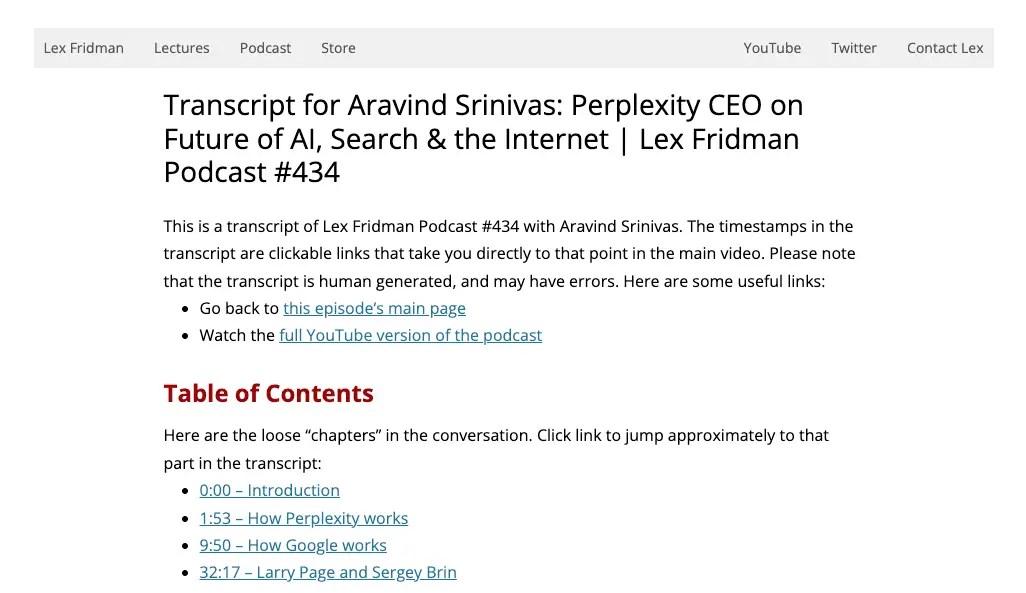
Transcript for Aravind Srinivas: Perplexity CEO on Future of AI, Search & the Internet | Lex Fridman Podcast #434 – Lex Fridman
23 Actual Content Metrics From Actual Marketers – Mateusz Makosiewicz, Ahrefs

An explanation of masked language models – Kinza Yasar, TechTarget

How Starbucks Devalued Its Own Brand – B. Joseph Pine II and Louis-Étienne Dubois, HBR

Great job making it to the end. You rock! 🪨
🤝 Want help with your SEO strategy?
I’m an independent SEO consultant focusing on custom audits and holistic strategies for brands. Don’t hesitate to reach out, or visit my about page for more information.
Let’s connect!
Hit me up anytime via text or call at 813-557-9745 or on social or email:
Cheers! ✌️

Leave a Reply