
Let’s Talk About “Segmentation” in the Context of SEO/GEO: A Hamsterdam Marketing Lesson
By Ethan Lazuk
Last updated:
Welcome to another edition of Hamsterdam Marketing! 🐹
This is a project where we examine marketing topics to learn about their fundamental concepts and apply them to the context of SEO/GEO.
This time, we’ll be looking at segmentation.
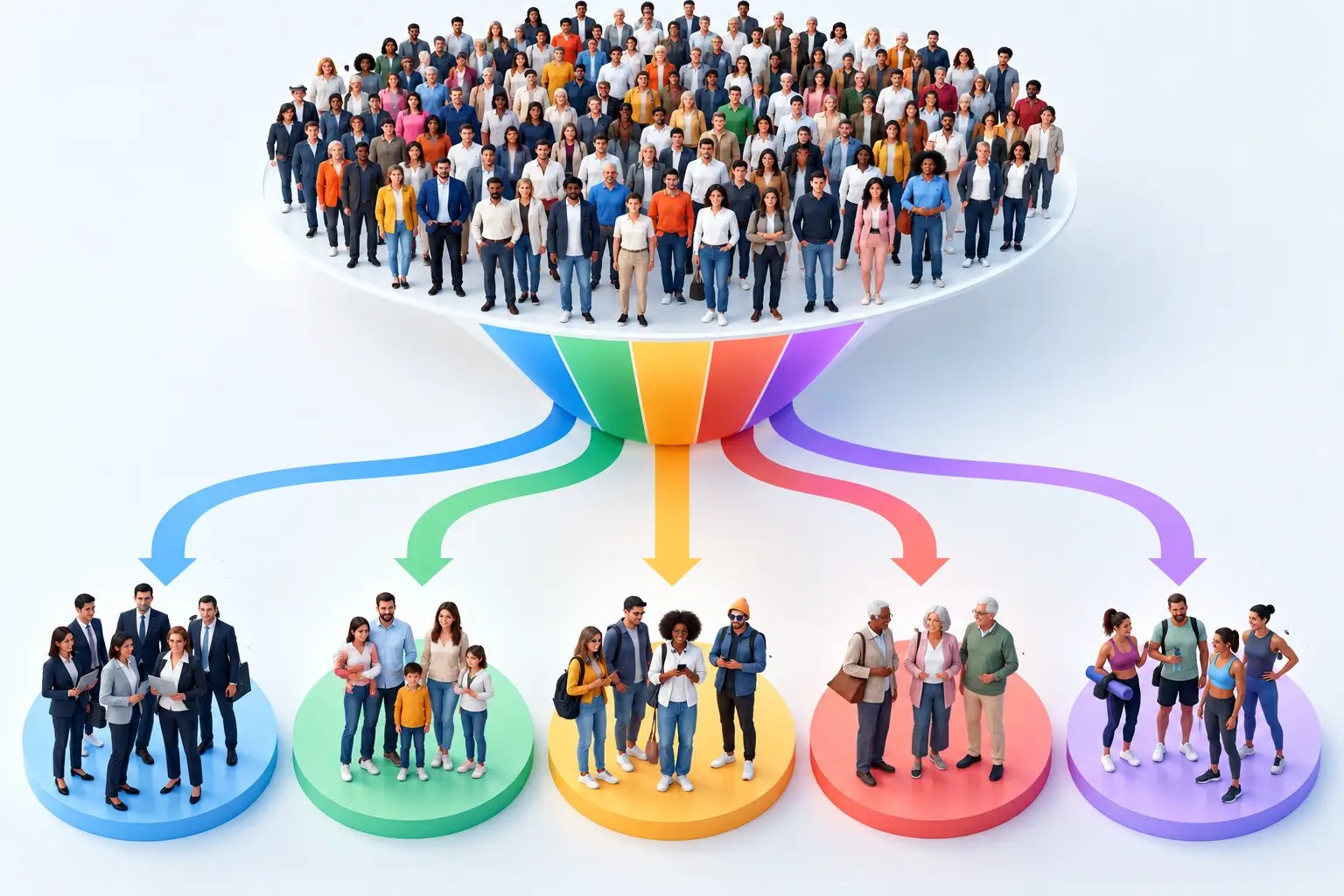
The story I’d like to tell here is how segmentation evolved from a way to divide markets into a way to divide information needs, which makes it a useful concept for SEO and AI search.
In its simplest form, market segmentation is the recognition that a market is heterogenous, meaning different people have different needs, motivations, behaviors, budgets, circumstances, and reasons for buying.
Rather than treating the market as one giant audience, segmentation seeks to answer which meaningful groups exist within the market and what are their different needs.
That part about different needs is important, because segmentation isn’t really about putting people in categories; it’s more so about determining when those categories tell you that you should do something differently, such as changing the product, pricing, advertising, or distribution.
In modern SEO/GEO, however, the difference between segments could mean differences in your content and how you create and organize it, such as with use-case or persona-based content.
A Bit of History on Segmentation

The concept of segmentation is usually traced back to Wendell R. Smith, who published Product Differentiation and Market Segmentation as Alternative Marketing Strategies in the Journal of Marketing in July 1956.
Smith was essentially comparing product differentiation and market segmentation as two ways that companies could respond to diverse consumer demand. While product differentiation seeks to make an offering distinctive yet broadly attractive within the market, market segmentation simply accepts that demand is different. Instead of trying to make everyone want roughly the same thing, a marketer using segmentation identifies groups with different requirements and develops offerings for them.
There were spin-offs of market segmentation, including benefit segmentation, coined by Russel Haley in 1968. Haley argued that categorizing customers using descriptive characteristics wasn’t enough and instead marketers should look at the benefits people are actually seeking from the product, because those motivations may better explain their purchase behavior.
Benefit segmentation is notable because it’s similar to a use-case or intent-based content strategy today.
From Demographics to Intent for Content Creation

While classic segmentation is often taught through categories such as demographic, geographic, psychographic and behavioral segmentation, those categories aren’t very useful for content.
Knowing that someone is 35 years old, lives in New York, and earns $100,000 may be valuable for advertisers, but for content creation for SEO/GEO purposes, it’s much more helpful to know that the person is a marketing manager trying to determine whether their company’s content appears in ChatGPT. Now you can create content specifically designed to solve that problem. That’s needs-based or use-case segmentation applied to content.
This approach is even supported by Microsoft’s guidance about AI-powered search, where Being said search becomes more conversational and intent-driven, so marketers whould think less exclusively about broad demographic groups and more about what the person is trying to accomplish with the query. (For a search engine like Bing, relevance is partly about how closely a page satisfies the intent behind a search.)
Thus, for content marketing for SEO/GEO purposes, the most useful segment is typically not who someone is, but what they’re trying to accomplish.
Personas Are One Way to Represent a Segment (Not the Segment Itself)

A segment is a group where members share strategically meaningful characteristics. That’s different from a persona, which is a simplified representation of someone within that group.
But the value of a persona is that it gives the segment a face. And for SEO/GEO strategies, a segment is usually more useful when you can connect it to specific questions, tasks, use cases, and search behavior that individuals would have.
Use-Cases Are Another Way to Represent a Segment

Fundamentally, search engines respond to queries, and queries frequently reveal something about the problem, stage, or intent of the person searching.
In their helpful content documentation, Google even tells publishers to think about whether they have an intended audience and that visitors should leave having learned enough to accomplish their goal.
Each use case creates a different vocabulary, questions, supporting evidence, and information hierarchy that you can use to sell a product or service through content marketing.
Persona-Based and Use-Case Content Gets Especially Interesting for AI Visibility

We know that Google’s AI Mode and AI Overviews can use query fanout, where the system generates related searches across different subtopics to construct a response. Now consider what that means for segmentation: AI search can potentially explore several different dimensions while forming an answer.
Therefore, content designed around real customer situations may provide more relevant material than one generic page attempting to address everybody.
That doesn’t mean create a page for every query fanout.
Before committing to creating a use-case or persona-based page, you must first determine whether the segment you’re targeting has meaningfully different information needs from the general market. If two audiences require the same product, same explanation, same examples, and same workflow, separate pages probably aren’t justified.
Real segmentation creates substantive differences in your content. Fake segmentation simply changes the noun in the H1. Remember that.
A Practical Segmentation Workflow for Content Creation
For SEO/GEO strategies, it’s better to think about content segmentation through five dimensions, rather than the textbook marketing framework:
| Dimension | Question |
|---|---|
| 1. Audience | Who has the problem? |
| 2. Problem | What are they trying to solve? |
| 3. Use case | What are they trying to accomplish with the product/information? |
| 4. Stage | Are they learning, comparing, buying, implementing, or troubleshooting? |
| 5. Context | What constraints materially change the answer? |
After determining the above five dimensions, next ask yourself whether the correct answer materially change for the segment? If yes, you probably have a legitimate content opportunity. If no, the segment probably belongs inside a broader page.
See you next time!
I hope you’ve found this discussion around segmentation helpful for your SEO/GEO content strategy.
Stay tuned for a new Hamsterdam Marketing lesson soon.
And if you want a hand with your SEO/GEO strategy, get in touch with me. I’m an independent consultant based in New York City.
Until next time, enjoy the vibes:
Thanks for reading. Happy optimizing!

Leave a Reply