
The AI Assistant Is Part of the Search Journey: What New Research, “Role of Personality in Conversational Information Seeking,” Means for SEO/GEO (Hamsterdam Research)
By Ethan Lazuk
Last updated:

Welcome to another edition of Hamsterdam Research! 🐹
This is where we look at recent AI research papers to learn what they’re talking about and explore their hypothetical implications for the future of search and SEO/GEO strategies.
This time, we’ll look at a research paper called, “Role of Personality in Conversational Information Seeking.“
It was published on August 11, 2026, and its authors are Abdisalam Abukar, Junchen Fu, Chengli Zhai, and Joemon M. Jose.
Why should SEO/GEO professionals care about this research paper?
The important finding in the research is that the AI assistant itself can help shape the user’s information-seeking journey. That has implications for how we think about prompts, search journeys, prompt tracking, content strategy, and brand visibility in AI search.
Traditional search tends to give us a relatively simple mental model: information need → query → search results → click.
Conversational search looks more like: information need → prompt → AI response → new or refined information need → follow-up → AI response → additional constraints → recommendation or decision.
The researchers describe conversational information seeking as moving away from one-shot querying toward ongoing dialogue in which users refine constraints, probe assumptions, and seek validation until they have enough information to act.
In other words, the prompt isn’t necessarily the entire search event anymore. It can be the beginning of a search journey, and this study provides empirical evidence that how the assistant behaves can alter how that conversational interaction unfolds.
That raises an important question for SEO/GEO: if the interaction changes, could the information and brands encountered throughout that journey change as well?
A lot of GEO measurement today involves a prompt, for example, “Give me the best CRM software.” That gets run multiple times and we track which brands appear and then calculate visibility.
That’s absolutely useful, but this paper raises a question about how representative single prompt-tracking is of real conversational search.
A real user might instead have a multi-turn conversation:
Turn 1:
“What’s a good CRM for a small business?”
Turn 2:
“We only have five salespeople.”
Turn 3:
“Salesforce sounds like overkill. What are simpler alternatives?”
Turn 4:
“Which of those integrates with QuickBooks?”
Turn 5:
“Compare HubSpot and Pipedrive for me.”
In that example, the final information need is substantially different from the initial one.
More critically, the AI assistant may have helped produce the turns in conversation by suggesting alternatives, asking questions, introducing criteria, or surfacing tradeoffs.
This research paper specifically describes conversational information seeking as a process in which the user’s query can evolve because the system suggests options, asks for missing information, or reformulates the task.
That’s a big deal.
If we had to condense the paper into one final idea, it would be that in AI search, the search engine is no longer merely responding to the user’s information need; through questions, recommendations, pacing, structure, and evidence, the AI assistant can participate in shaping how the user’s information need develops.
Let’s start by reviewing the paper’s abstract.
Here’s the abstract (with my highlights):
“Large language models (LLMs) are increasingly used for information seeking, where users find, compare, and evaluate information through dialogue. In this role, the assistant (LLM) does more than retrieve or generate content — it actively mediates how users articulate constraints, pose follow-up questions, verify claims, and determine when an answer is sufficient for action. Despite this influence, little is understood about how user personality, assistant personality, and task context jointly shape such interactions. We examine personality as a controllable variable in conversational information seeking, with the aim of understanding its effects on user behaviour and interaction quality. Hence, we designed a controlled, within-subject interactive study in which assistant personality and task type were experimentally varied, while participant personality was measured using Big Five scores. Twenty-six participants each completed three information-seeking tasks across three assistant personality conditions — an extraverted style, a conscientious style, and a neutral baseline. The tasks spanned three distinct domains: exploratory travel planning, comparative smartphone shopping, and verification-sensitive health and diet information seeking. Data were collected through conversation logs, behavioural traces, post-interaction questionnaires, an exit questionnaire, and Big Five personality measures. The assistant conditions were behaviourally distinguishable: the extraverted assistant produced longer assistant turns, the conscientious assistant yielded higher user word share and more turns, and the neutral baseline fell between them. The strongest effect was a task-by-assistant interaction on trust and delegation, with preferred styles varying by task. No global winner emerged, but participants strongly favoured style choice or adaptation. These findings position assistant personality as a context-sensitive, interactional design variable rather than a globally optimisable system property.“
Next, let’s break down the paper’s key vocabulary terms:
- Conversational Information Seeking (CIS): Information seeking that unfolds through multiple turns of dialogue rather than a single query and response.
- Assistant Personality: The expressed interaction style of the LLM, such as extraverted, conscientious, or neutral. The researchers treat this as a prompted style, not a literal psychological trait.
- Participant–Assistant Compatibility: The degree to which the AI assistant’s expressed style aligns with the user’s personality or preferred interaction style. The study found this was especially relevant to trust and delegation.
- Task–Assistant Compatibility: How well a particular assistant style fits a particular type of information-seeking task, such as exploration, comparison, or verification.
- Task Ecology: The broader nature and demands of an information-seeking task. The paper distinguishes exploratory travel planning, comparative shopping, and verification-sensitive health research.
- Trust and Delegation: A combined measure of how much users trusted the AI assistant and were willing to rely on it when making judgments or decisions
- Behavioural Traces: Observable features of the conversation, including response length, turn count, user word share, follow-up turns, and question behavior.
- Interaction Friction: Difficulty or inefficiency within the conversation, such as excessive clarification, repeated checking, excessive questioning, or slow convergence toward an answer.
- Mixed-Initiative Behavior: When the assistant actively participates in directing the search process, like by asking clarifying questions or helping refine the user’s information need instead of merely answering.
- Verification-Sensitive Information Seeking: Information seeking where users place greater emphasis on evidence, accuracy, caution, and independent verification.
Based on the paper, I’d say the most useful terms are “Conversational Information Seeking,” “Task Ecology,” “Mixed-Initiative Behavior,” “Task–Assistant Compatibility,” and “Trust and Delegation.”
Cool beans. Let’s take a deeper look at the research paper’s contents now.
If you want to follow along, you can grab a PDF or the HTML version on arXiv.
The full paper has 8 sections.
We’ll summarize the main ones below.
1. Introduction
The researchers first explain how “retrieval effectiveness is shaped not only by relevance but also by how the system communicates, motivating investigation into the role of personality in conversational search.”
“This shift makes conversational style a consequential design factor in conversational information retrieval,” they continue
“In chatbot-based search and question answering, an assistant may engage in more mixed-initiative behavior by asking clarifying questions (2), provide more directive recommendations, impose stronger dialogue structure (32), or adopt a more socially expressive tone (18). Such stylistic choices influence not only the flow of the interaction but also user trust, engagement, and interaction efficiency, even when the underlying retrieval or language model and task remain unchanged.”
They continue by noting differences in user preferences regarding an AI assistant’s personality: “the same assistant personality may foster trust and engagement for one user while reducing efficiency or satisfaction for another.”
Therefore, “the assistant’s expressed style must be aligned with both the task context and the user’s interaction preferences in order to support effective, trustworthy, and efficient information seeking.”
They study this problem through a “controlled user study in which participants interacted with three LLM assistants across three information-seeking tasks.”
“The assistants were implemented using the same base model (gpt 4.1) but different system prompts,” they write.
They conclude by noting that “The paper’s contribution is empirical rather than prescriptive.”
“We do not advocate for a single optimal assistant personality. Instead, we provide evidence that: (i) assistant style produces distinguishable behavioural interaction patterns; (ii) task context moderates trust and delegation outcomes; and (iii) participant–assistant personality compatibility explains more variance than broad trait-to-behaviour effects. These results support a contextually grounded view of personality-aware LLM design, in which style is treated as a situational interaction variable rather than a universally beneficial system property. In this sense, assistant style is not a cosmetic property but a functional one: it shapes how initiative is distributed, how user constraints are surfaced, how strongly recommendations are framed, and how claims are evidentially grounded.”
2. Related Work
- A Theoretical Framework for Conversational Search is foundational to the paper’s basic premise: it models conversational search as an ongoing interaction in which the system can ask questions, receive feedback, present results, and retain context rather than simply respond to one query, providing the theoretical basis for thinking of AI search as a search journey rather than a query-response event.
- Asking Clarifying Questions in Open-Domain Information-Seeking Conversations studies the role of clarifying questions when the user’s information need is ambiguous or incomplete, demonstrating that clarifying questions are one mechanism through which an AI assistant can actually change the direction of a search journey, surfacing new constraints and producing subsequent prompts that may never have occurred otherwise.
- TREC CAsT 2019: The Conversational Assistance Track Overview supports the idea that the literal words in an individual conversational query don’t necessarily capture the complete information need; context across turns matters.
- Conversational Information Seeking shows that prompts should not simply be conceptualized as the AI-search equivalent of keywords.
- Retrieval-Augmented Generation for Knowledge-Intensive NLP Tasks was a foundational RAG paper combining a generative model with retrieval from external information.
- Machines and Mindlessness: Social Responses to Computers was classic research showing that people often apply social rules and expectations to computers even though they know they’re interacting with machines, providing the psychological foundation for why an LLM’s tone, confidence, warmth, initiative or structure might influence user behavior.
- Trainable Generation of Big-Five Personality Styles through Data-Driven Parameter Estimation demonstrated that language-generation systems could produce linguistic styles associated with Big Five personality dimensions, helping establish that traits such as extraversion and conscientiousness can be represented through observable linguistic behaviors, which is exactly how the current study operationalizes assistant personality (rather than claiming that an LLM literally possesses a psychological personality).
- Personality Traits in Large Language Models explores methods for measuring and deliberately shaping personality-like characteristics in LLM outputs, finding that prompting can produce outputs corresponding to different personality profiles and establishing that assistant personality can be manipulated through prompting.
- Effect of LLM’s Personality Traits on Query Generation investigates whether personality traits assigned to LLM agents affect how those agents formulate search queries and their resulting search performance, suggesting that personality isn’t necessarily just a presentation layer after retrieval; it can potentially influence the queries involved in search itself.
- The Impact of Personality Traits on Users’ Information-Seeking Behavior represents the earlier research suggesting that who the searcher is may affect how they search.
- Personality and Information Behavior in Web Search creates an interesting bridge from traditional web search behavior to conversational search behavior.
- Style and Alignment in Information-Seeking Conversation and Expressions of Style in Information-Seeking Conversation with an Embodied Agent help establish the idea of interactional alignment, where users don’t necessarily communicate independently of the system, but rather their behavior can adapt to it.
- Understanding the Effects of Conversational Agent Personality on the Credibility of LLM-Based Conversational Search examines assistant personality and perceived credibility in LLM-based conversational search, helping establish that personality or style can affect something more consequential than whether users enjoy the interface but whether they believe and trust the information it presents.
- Consumer Evaluation of the Quality of Online Health Information found that judgments about online health information involve numerous quality criteria and are highly contextual, helping explain why the current study deliberately included a verification-sensitive health task.
3. Method
The study was designed to isolate how user personality, assistant personality, and task context interact during conversational search.
Each participant encountered an extraverted, conscientious, and neutral assistant while completing exploratory, comparative, and verification-sensitive tasks. The order was counterbalanced to reduce bias.
Table 1 shows the three versions of the AI assistant participants interacted with. All three used the same underlying model, but what changed was the system prompt controlling the conversational style.
Planet names were deliberately neutral so participants didn’t know which personality they were interacting with until after the experiment. That helped reduce bias.

Table 2 shows the three different kinds of search journeys participants completed. The researchers chose them because each requires a different style of information seeking.
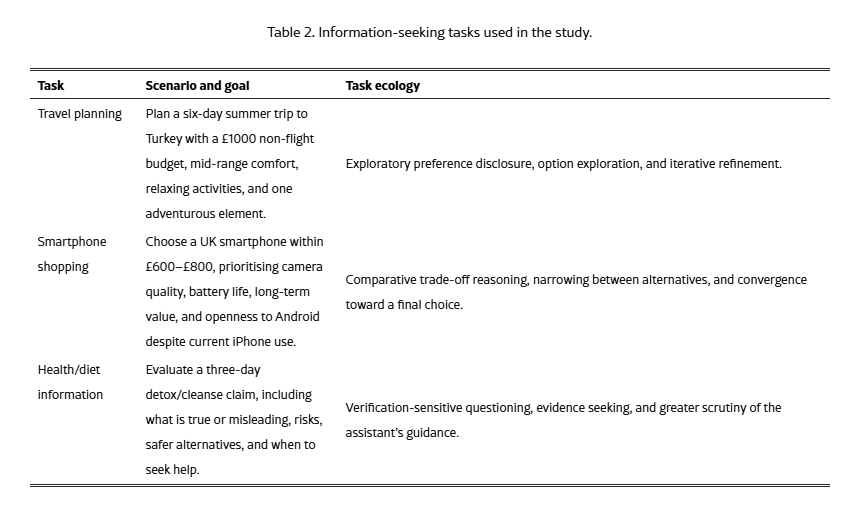
The researchers weren’t merely comparing three assistant personalities. They were testing whether those personalities worked differently depending on the type of information-seeking task.
4. Experiment Setup
The experiment was designed to isolate assistant interaction style as the primary variable.
Figure 1 shows how the experiment worked for participants and researchers:

Panel A shows the participant-facing conversation interface. (In this example, the user is doing the travel-planning task with the conscientious assistant.)
Interestingly, rather than producing an itinerary immediately, the AI assistant acknowledged the user’s constraints and asked a clarifying question about priorities. That illustrates multi-turn information seeking.
Panel B shows the researcher-facing experimental setup. Each participant was assigned an order for the three assistant conditions and an order for the three tasks. Different participants encountered the AI assistants and tasks in different orders, which helped prevent bias.
5. Experiment Results
Table 5 shows that the three assistant styles produced different conversation patterns, even though they all used the same underlying model:

The extraverted assistant (Titan) gave the longest responses, users contributed the smallest share of the conversation, and there were about 4.19 turns per interaction. In other words, Titan tended to dominate the conversation more.
The conscientious assistant (Europa) gave the shortest responses, users contributed the largest share, and conversations had 4.85 turns. In other words, Europa tended to leave more room for the user, creating more back-and-forth.
The neutral assistant (Neptune) sat between the two on all three measures.
Different styles were also favored for different task ecologies:
- Exploratory travel: extraverted
- Comparative shopping: neutral
- Verification-sensitive health: conscientious
Main takeaway: prompted assistant personality changed the structure of the conversation with different personalities favored for different tasks.
6. Conclusion
“In a within-subject study with 26 participants, three assistant styles, and three task ecologies, the results did not support a single universally best persona,” the authors conclude. “Instead, the clearest pattern was task–style fit.”
“Titan was strongest for exploratory travel planning, Neptune for comparative shopping, and Europa for verification-sensitive health information, with trust and delegation showing the clearest supported task-by-assistant interaction. Participant personality was not a strong direct predictor of surface trace behaviour, but compatibility between participant and assistant style was associated with trust-related outcomes. This distinction is important for personality-aware conversational search: personality should not be reduced to a user trait, an assistant label, or a verbosity setting. It is expressed through pacing, initiative, evidence, and structure, and it is interpreted in relation to the user’s task.“
“These findings suggest that assistant personality should be treated as a configurable and task-sensitive interaction parameter rather than as a fixed default persona,” they write.
“For conversational search system design, this means that assistant style should be evaluated with task-specific outcomes, trust and delegation should be distinguished from general liking, and personalization should combine user control with transparent adaptation rather than encouraging unwarranted reliance.”
Future work, they suggest, “should combine personality-aware interaction analysis with stronger answer-quality evaluation, grounding checks, and larger, more diverse samples.” Additionally, “Future work could further explore richer multimodal interaction and modeling.”
Knowing what we do now, why should SEO/GEO professionals care about “Role of Personality in Conversational Information Seeking”?
SEO/GEO professionals should care about this research because AI search is not just traditional search with longer queries; it is an interactive process in which the assistant can influence how the user’s information need develops, what they trust, and when they are ready to act.
Here are five primary takeaways:
1. AI search is a journey, not a single prompt.
The paper treats conversational information seeking as a sequence of interactions in which users refine constraints, ask follow-ups, and develop their information need over time. That means a single tracked prompt may only capture one moment in a much broader search journey.
2. The assistant can shape the search behavior itself.
The different prompted personalities in the research changed response length, user participation, and turn count. This suggests that AI assistants are not neutral interfaces, but rather how they respond can influence what users do next.
3. “Task ecology” may matter more than the prompt alone.
In the research, exploratory travel planning favored the extraverted style, comparative shopping favored the neutral style, while verification-sensitive health research favored the conscientious style. This evidence reinforces the importance of understanding a user’s motivations rather than treating all AI visibility the same.
4. “Trust and delegation” are important outcomes beyond simple visibility.
Whether users trusted the AI assistant and were willing to rely on it was an important aspect of the study. This means that appearing in an AI-generated answer is only one step. The bigger question is whether the information (and recommendation) is presented in a way that users feel comfortable acting on.
5. Prompt tracking may eventually need to become journey tracking.
While the paper didn’t study GEO measurement or brand visibility directly, its findings nonetheless suggest a potential limitation of single-prompt tracking. If a user’s needs evolve across turns and the AI assistant helps shape those turns, then SEO/GEO measurement needs to not simply ask, “Did my brand appear for this prompt?” but also “When does my brand enter, stay in, or disappear from the conversation as the user narrows their decision?”
This research paper supports the premise that conversational search is dynamic and shaped by the user, assistant, and task jointly.
Caveat: Before extrapolating these findings to SEO/GEO, it’s worth remembering this research wasn’t an experiment about brand visibility, citations, or retrieval. It was a relatively small controlled study of how conversational style affected interaction behavior and user perceptions. Any GEO implications above are hypotheses informed by the research and not conclusions demonstrated by it.
Outro
I hope you’ve enjoyed this edition of Hamsterdam Research! 🐹
Feel free to comment below or contact me with your feedback.
Stay tuned for another new article, hopefully next week, or check out related research posts below.
Until next time, enjoy the vibes:
Thanks for reading. Happy optimizing!

Related research articles:

Exploring “Scalable In-context Ranking with Generative Models,” a Google Research Paper, & Why SEO/GEO Professionals Should Care (A Hamsterdam Research Post)
Exploring “Scalable In-context Ranking with Generative Models,” a Google Research Paper, & Why SEO/GEO Professionals Should Care (A Hamsterdam Research Post) By Ethan Lazuk Last updated: Welcome to a new edition of Hamsterdam Research! 🐹 If you’re new here, this is where we look at recent AI research papers to learn just what the heck…

Exploring “GuidedRAG: Semantic Steering of Retrieval-Augmented Generation” and Why SEO/GEO Professionals Should Care (Hamsterdam Research)
Exploring “GuidedRAG: Semantic Steering of Retrieval-Augmented Generation” and Why SEO/GEO Professionals Should Care (Hamsterdam Research) By Ethan Lazuk Last updated: Welcome to a new edition of Hamsterdam Research! 🐹 This is where we look at recent AI research papers to learn just what the heck they’re talking about and explore their hypothetical implications for the…

The Prompt Isn’t Always the Query: What Conversation Context Means for SEO and GEO (Hamsterdam Research)
The Prompt Isn’t Always the Query: What Conversation Context Means for SEO and GEO (Hamsterdam Research) By Ethan Lazuk Last updated: Welcome to another edition of Hamsterdam Research! 🐹 This is where we look at recent AI research papers to learn what they’re talking about and explore their hypothetical implications for the future of search…
Leave a Reply