
How to Optimize for a Knowledge Panel on Google (And Why That’s Only the Beginning)
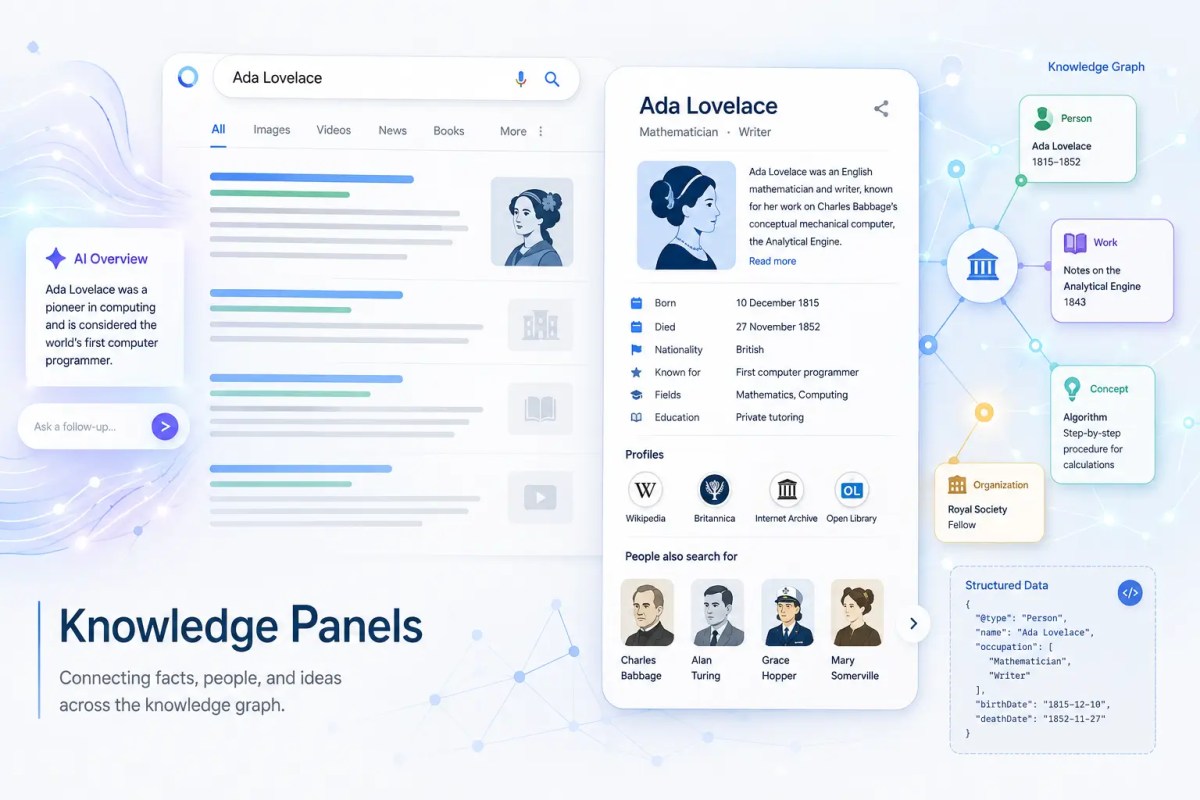
Come for the knowledge panel optimization tips, stay for the entity corroboration lesson.
Google’s entity layer is becoming part of the AI search interface, not merely a traditional SERP feature.
Ahrefs documented examples where entities mentioned inside AI Mode responses are clickable and underlined, and clicking them opens a knowledge graph information panel about the entity.
Such knowledge panels can also show Search Profiles now:
Google also notes that “AI Overviews use a customized Gemini model, which works in
tandem with our existing Search systems – like our quality and ranking systems and the Google Knowledge Graph.”
Google continues: “AI Mode taps into real-time information from the web and from Google, like facts from our Knowledge Graph, info about the real-world, and shopping data for over 50 billion products.”
And regarding AI Mode, Google says: “The agentic RL also encourages the model to retrieve and add additional factual information to its claims from info sources like our Knowledge Graph.”
Furthermore, on July 15, 2026, Search Engine Land reported that Google-owned results had become the second-most-cited domain in AI Mode in Profound’s dataset. Google.com citations increased 8.4x between April 15 and June 30. Most of that increase came from Google Business Profiles and Product Knowledge Panels being surfaced inside AI Mode responses.
All of that is to say that the user journey is evolving:
Instead of: AI Mode → brand website.
We’re increasingly seeing something like: AI Mode → Google’s understanding of the entity or product → Google-hosted panel → website (particularly for local and product searches).
That’s potentially pretty significant for entity optimization.
It also brings us to another caveat:
- Knowledge Panel = an interface/display.
- Knowledge Graph = Google’s underlying entity or fact system.
From an SEO/GEO perspective, I would argue that the real goal isn’t simply: “Get a Knowledge Panel.”
It’s: “Make Google confidently understand the entity and its relationships.”
A knowledge panel is thus simply evidence that Google recognizes and understands the entity well enough to represent it in the knowledge graph and surface a panel for relevant searches.
Having said all of that, how do you optimize for a knowledge panel?

Google doesn’t really provide a “knowledge panel checklist.”
In fact, Google’s official position is that such panels are created automatically when its systems have enough information available on the open web.
You generally cannot request Google to create a knowledge panel, either, however, eligible publishers and creators can claim a Search Profile, which may trigger the creation of a knowledge panel. (An existing knowledge panel can also be enhanced with the Search Profile and recent content.)
Thus, knowledge panel optimization is more like entity disambiguation and corroboration than on-page optimization.
The strategy for getting a knowledge panel breaks down into five key areas:
1. Establish a canonical entity home
An entity home is a homepage, about page, or another page on your website that thoroughly explains the entity; it’s where the entity lives, so to speak. This isn’t Google’s terminology; it’s that of SEO practitioners.
The language describing the entity should be unambiguous, and one way to achieve this is using semantic triples, such as: Ethan Lazuk is an independent SEO/GEO consultant.
2. Give Google machine-readable identity information
Google says adding Organization structured data can help it understand your organization’s administrative details and disambiguate your organization, and some fields can affect things displayed in the knowledge panel, including the logo.
Consider adding:
- Organization
- name
- alternateName
- url
- logo
- sameAs
- address
Ahrefs further recommends a stable @id and using sameAs to connect official profiles and recognized identity pages.
Google also supports ProfilePage structured-data, where Person can be the mainEntity, including properties like name, alternateName, description, image, and sameAs.
Just remember, schema doesn’t magically create a knowledge panel. It simply reduces ambiguity.
3. Corroborate the entity elsewhere on the web
Google says knowledge graph facts come from many public sources, licensed data, and information supplied by content owners.
That means it likely takes a degree of corroboration to establish your entity.
Claiming yourself to be an independent SEO/GEO consultant isn’t enough. Google likely needs to see that information reaffirmed from third-party sources.
These sources might include:
- authoritative media mentions
- professional organizations
- industry publications
- interviews
- conference profiles
- company databases
- social profiles
- directories
- awards
- podcasts
- author pages
Ahrefs recommends authoritative PR/mentions because these sources give Google additional evidence that your entity exists and is notable.
Just remember, the facts need to be consistent. Not verbatim, necessarily. We’re looking for semantic consensus.
4. Connect the entity to other established entities
Google’s knowledge graph doesn’t just consist of entities but also relationships between them.
In my case, entity relationships might look something like:
- Ethan Lazuk Consulting, LLC → founded by → Ethan Lazuk
- Ethan Lazuk Consulting, LLC → provides → SEO/GEO consulting
- Ethan Lazuk Consulting, LLC → headquartered in → New York City
- Ethan Lazuk → Owner of → Ethan Lazuk Consulting, LLC
- Ethan Lazuk → writes about → SEO/GEO
It’s all about who you are and what you’re associated with.
As a side tip, you can use fanout queries to help understand entity relationships for content ideation.
5. Claim the panel once Google creates it (if eligible)
Congratulations. Your panel is now created and may be eligible to be claimed.
If eligible, you claim your panel through Google.
Once claimed, you may be able to influence things like:
- description
- images
- social profiles
- factual corrections
- official website
But even then, you don’t technically control your panel. Google ultimately decides what happens with it.
What about Wikipedia and Wikidata, you ask?
Wikipedia and Wikidata can be powerful entity corroboration sources when an entity qualifies for them, but neither should be treated as a prerequisite (or manipulated) to trigger a Knowledge Panel.
Google looks at a variety of sources for corroboration. Your best bet is to organically reinforce your entity relationships around the web, starting with all of the profiles you control and then using digital PR or other methods to branch out from there.
Takeaways
Knowledge panel optimization isn’t really about optimizing a panel.
It’s about: entity definition → disambiguation → corroboration → relationship building → stronger entity understanding.
Which can produce: knowledge graph recognition → multiple possible search surfaces (knowledge panels, AI Mode, AI Overviews, and other entity-rich search experiences).
Thus, our ultimate takeaway here is a vocabulary lesson: entity corroboration, or reinforcing consistent facts about an entity across independent, authoritative sources so search systems can confidently identify the entity and understand its attributes and relationships.
If you need help with strategies for AI search, feel free to contact me. I’m an independent SEO/GEO consultant helping brands and agencies.
Until next time, enjoy the vibes:
Thanks for reading. Happy optimizing!

Related posts
Query Fanout as an Entity Optimization Strategy for AI Search
Query Fanout as an Entity Optimization Strategy for AI Search I’ve written before about how entity optimization for AI search isn’t a checklist of tactics…
Entity Optimization for AI Search: Reducing Ambiguity and Increasing Retrievability
Entity Optimization for AI Search: Reducing Ambiguity and Increasing Retrievability Entity optimization for AI search isn’t a checklist of SEO/GEO tactics; it’s a holistic process…
Let’s Talk About “Brand Positioning” in the Context of SEO/GEO: A Hamsterdam Marketing Lesson
In this first Hamsterdam Marketing lesson, we’ll talk about personas, how to create them, and how they apply to SEO strategies and content creation.
Leave a Reply